















What is Gonka AI: Decentralized Network for AI Computations
In 2026, artificial intelligence has become one of the most resource-intensive fields in technology. Training modern models requires thousands of powerful GPUs, and their shortage combined with sky-high costs has turned AI access into a privilege reserved for big corporations. Gonka AI offers a fundamentally different approach — a decentralized compute network where anyone with powerful hardware can become part of the global AI infrastructure. The project is frequently called “Bitcoin for AI” because it combines token economics, blockchain openness, and genuinely useful GPU workload. In this article, we break down what Gonka is, who’s behind it, how the network operates, and why it’s attracting serious attention from investors and miners.

What is Gonka AI and what problems does it solve
Gonka AI is a decentralized platform focused on inference (running queries against models) and training large language models (LLMs). Thousands of GPUs around the world are pooled into one unified distributed network that competes directly with AWS, Google Cloud, and Azure on both price and availability.
The core problems Gonka addresses:
- Exorbitant compute costs — training a single cutting-edge model can run into millions of dollars, while renting an H100 for a month costs tens of thousands.
- GPU scarcity and reliance on a handful of suppliers.
- Centralized control over data and models held by Big Tech.
Gonka reduces inference and training costs by 50–70%, making high-end compute power accessible to independent developers, startups, and researchers. For a deeper look at the concept and why decentralized compute is emerging as one of the defining trends of 2025–2026, read the Forbes article and visit the official project site: https://gonka.ai
The network operates around three key roles:
- Hosts — GPU owners who connect hardware and execute tasks
- Developers — creators of AI applications who pay for compute
- Users — end users of chatbots, APIs, and other products
A defining feature is Proof of Work 2.0 (also called the Sprint mechanism): unlike Bitcoin, where nearly all energy is wasted on meaningless hashing, in Gonka ~100% of compute power is directed toward real AI workloads.
Team and Founders
The project was founded by brothers David and Daniil Liberman — Silicon Valley entrepreneurs with deep experience in AI, AR, and mobile tech.
In 2016 they launched Kernel AR, which was acquired by Snap Inc. just months later for $30–40 million. They then founded Product Science — an AI-powered mobile app optimization company backed by Coatue Management, Slow Ventures, and other prominent funds.
Their hands-on experience building distributed systems and working with AI directly inspired Gonka. In a January 2026 interview with U.Today the brothers said: “Gonka is the result of Web2 AI researchers meeting Web3 miners. We want AI to become as open as the internet was in the 90s.”
The team deliberately avoids excessive power centralization and is progressively handing governance over to the community.
Gonka and Blockchain
Gonka is an L1 blockchain built on Cosmos SDK. This delivers high throughput, low fees, and seamless interoperability with other chains via IBC.
The native token is GNK. It is used for:
- paying for compute
- validator staking
- governance participation
The consensus mechanism is a modified Proof of Work called Sprint, where nodes compete to perform useful AI tasks. Full technical details are available in the whitepaper: https://gonka.ai/whitepaper.pdf
Competitors
The decentralized AI market is already quite crowded. Here are the main projects most frequently compared to Gonka:
- Bittensor (TAO) — decentralized intelligence marketplace where different AI models compete for rewards and ranking
- Render (RNDR) — distributed network for graphics rendering and AI workloads on GPU
- Akash Network — decentralized cloud allowing global rental of compute resources
- io.net — GPU power marketplace connecting graphics card owners with AI and machine learning compute demand
In 2025–2026, TON (The Open Network) from Telegram and Tether both announced major AI initiatives.
- TON launched COCOON (Confidential Compute Open Network) — a decentralized private-compute network for AI built on TON blockchain (announced October 2025, live November 2025). GPU owners can supply compute power and earn TON rewards while preserving data confidentiality.
- Tether is developing QVAC — a platform for local and decentralized AI where models run directly on user devices without cloud servers, emphasizing privacy and autonomy (announcements and infrastructure investments throughout 2025–2026, including a 20,000+ GPU network).
Gonka stands out by focusing strictly on useful PoW (all compute goes toward real AI tasks) and has already aggregated over 6,000 H100-equivalent GPUs in the first months following mainnet launch.
How GNK is mined
Mining GNK means supplying GPU power to execute real AI workloads (inference, fine-tuning, training).
The process works as follows:
- Host connects high-end hardware (H100, A100, Blackwell, etc.)
- Receives a task from the network
- Performs inference or training
- Result is verified by validators via cryptographic proofs
- Receives GNK reward
Validators (nodes with locked stake) check computation correctness and earn their share.
To buy and sell GNK tokens conveniently use HeX Exchange — a decentralized orderbook platform. Direct link to the Gonka market
HeX advantages:
- best prices (true P2P, no middlemen)
- no mandatory KYC
- referral program (50% of commissions)
- secure escrow transactions
- full decentralization (no central authority — all deals are direct user-to-user via smart contracts)
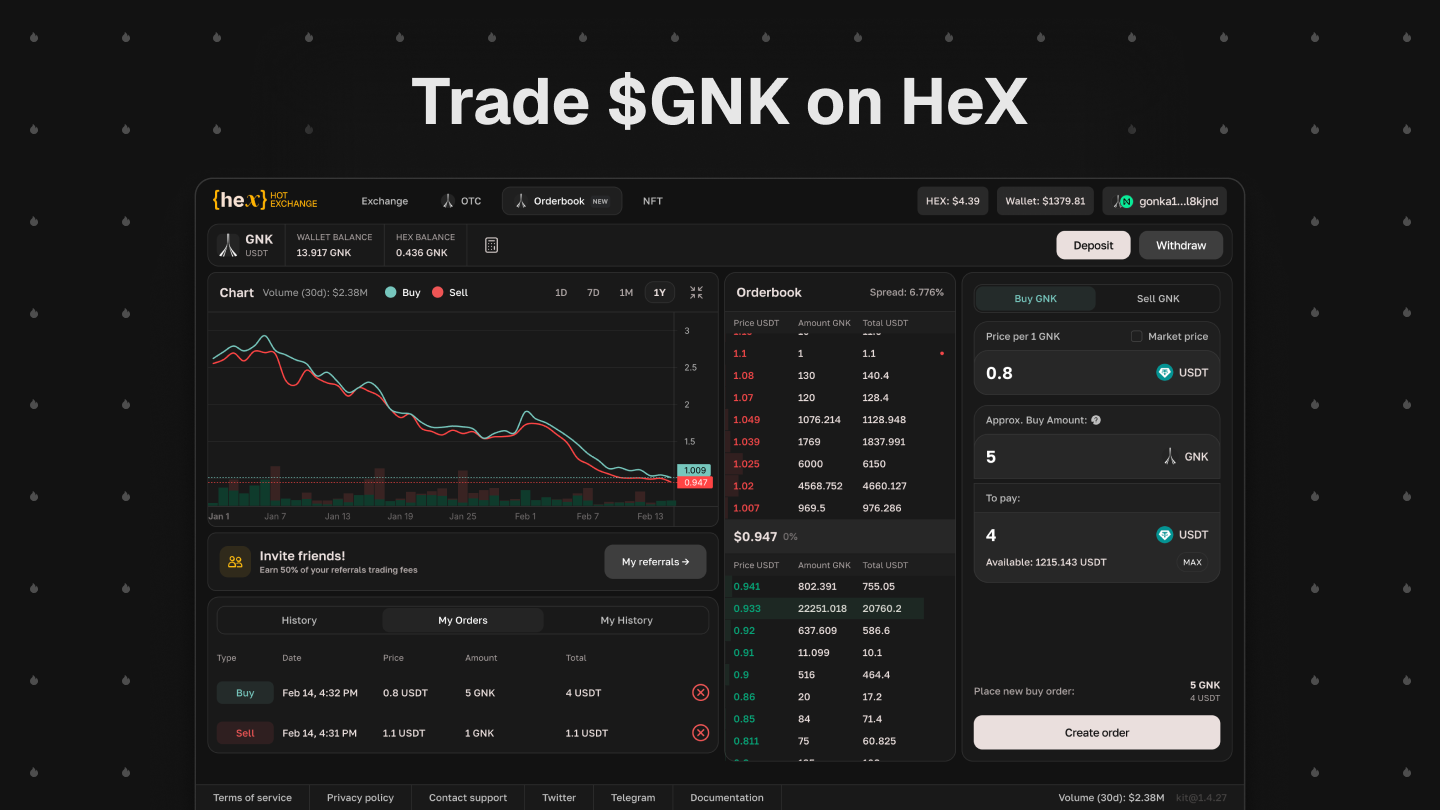
This is currently one of the most convenient and cost-effective ways to trade GNK on the secondary market.
Tokenomics (brief)
From the official document https://gonka.ai/tokenomics.pdf:
- Maximum supply: 1,000,000,000 GNK
- Allocation:
- ~40% — miners / hosts for useful work
- ~20% — ecosystem & developer grants
- ~15% — team (long vesting)
- ~10% — early investors
- ~15% — liquidity & reserves
Most miner rewards are subject to vesting (3–6 months), reducing immediate sell pressure.
Investments
As of late 2025 – early 2026 Gonka has raised approximately $80 million:
- 2023 — $18 million (Coatue, Slow Ventures, K5, etc.)
- November 2025 — $12 million from Bitfury (20 million GNK at $0.60)
- December 2025 — $50 million from Bitfury Capital (first tranche of their $1 billion ethical AI fund)
Bitfury — one of the largest players in traditional mining — views Gonka as the next evolution of compute networks.
Conclusion
Gonka AI is one of the most compelling projects at the intersection of AI and blockchain in 2026. A strong founding team, live network operations, genuinely useful consensus, and major backing from Coatue and Bitfury position it as a serious contender for leadership in the DeAI space.
If you want to get involved — connect GPUs as a host, deploy your models as a developer, or simply invest in the GNK token. The most convenient way to buy and sell right now is on HeX.
Official website: https://gonka.ai
An active community is what keeps decentralized projects alive. If you’re already diving into the DeAI world, join discussions and get quick answers in communities like HOT Wallet (built on NEAR) — plenty of people there are already working with similar networks:
- Discussions on Reddit →
- Video guides on YouTube → https://www.youtube.com/@hot-labs
- News & chat on X → https://x.com/hotdao
- Quick tips on Instagram → https://www.instagram.com/hot_labs
- Fast updates on Telegram → https://t.me/hot_wallet
- In-depth articles on Medium → https://hot-labs.medium.com/
- Download HOT Wallet → https://download.hot-labs.org/blog_hot_gonka_eng


